Posted by kazvorpal on July 13, 2010
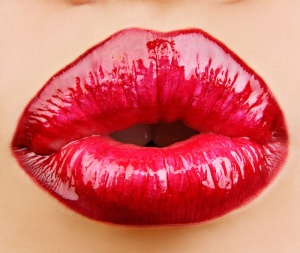 Osculation
v. To kiss, or come into contact with something or someone in a way that could be referred to as kissing by simile
This may not be the most romantic way to say “kiss”, but it’s certainly among the most interesting
All animals copulate but only humans osculate. Parakeets rub beaks? Sure they do, but only little old ladies who murder schoolchildren with knitting needles to steal their lunch money so that they can buy fresh kidneys to feed overweight kitty cats would place bird billing in the realm of the true kiss.
— Tom Robbins, Wild Ducks Flying Backward (2005)
He kissed the plump mellow yellow smellow melons of her rump, on each plump melonous hemisphere, in their mellow yellow furrow, with obscure prolonged provocative melonsmellonous osculation.
— James Joyce, Ulysses (1923)
According to a famous Yale professor
“Osculation is a sensation that is nice”
— Dean Martin, Tonda Wanda Hoy (1951)
Greetings, Gate. Let’s osculate.
— Daffy Duck, The Wise Quacking Duck (1943)
Etymology: From the Latin osculum, literally “little mouth”
Posted in humor, poetry | Tagged: ausculate, big words, dean martin, euphemism, euphemisms, high vocabulary, james joyce, kiss, kisses, kissing, liplock, making out, new words, osculate, parakeet, quotations, similes, tom robbins, tonda wanda hoy, ulysses, vocabulary, vocabulary expansion, wild ducks flying backward | 1 Comment »
Posted by kazvorpal on October 9, 2009
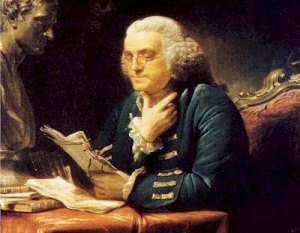
Ben Franklin may be best known for the apothegms he printed in Poor Richard's Almanac, such as "apenny saved is a penny earned", and "haste makes waste".
Apothegm archaic sp: Apophthegm
n. A short witty instructive saying; an aphorism or maxim.
Ben Franklin may be best known for the apothegms he printed in Poor Richard’s Almanac. Julius Caesar did write a collection of apophthegms, as appears in an epistle of Cicero, so did Macrobius, a consular man…they are mucrones verborum, pointed speeches. “The words of the wise are as goads,” saith Solomon. Cicero prettily calleth them salinas, salt-pits, that you may extract salt out of, and sprinkle where you will. — Francis Bacon, “Apophthegms, New and Old” (1625) Etymology As these ten dollar words often are, this one has a neoclassical, Renaissance origin: “To speak plainly”, in Ancient Greek: apo: from; phthengesthai: to speak
Posted in Knowledge, rhetoric | Tagged: aphorisms, apophthegms, apothegms, bacon, ben franklin, francis bacon, high vocabulary, quotations, quotes, sayings, vocabulary, vocabulary words, word, word of teh day, word of the day, wotd | 1 Comment »
Posted by kazvorpal on October 5, 2009
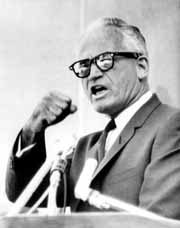
Barry Goldwater, delivering a hortatory speech
Hortatory
adj. Giving exhortation or advice; encouraging; exhortatory; inciting; as, a hortatory speech.
Considering the avowed purpose of his work, which is rather hortatory than historical, we are fortunate indeed to be given so much first-hand information by this embittered preacher.
J N L Myres, in R G Collingwood and J N L Myres Roman Britain and the English Settlements (1937) p. 329
Etymology
15th century, neoclassical Latin, Hortati means “to exhort”, an intensified version of Horiri, “to urge”.
Posted in rhetoric | Tagged: barry goldwater, exhortation, exhortatory, goldwater, goldwater girls, hortatory, public speaking, quotations, rhetoric, speaking, speech | Leave a Comment »


 High-Vocabulary Word of the Day